
What 100buy’s warehouse sees of a mains item, and what it leaves to you
The warehouse looks at the box, the casing and the bits in the bag. It does not plug anything in.
Inspection without switching it on
100buy’s warehouse opens incoming parcels, weighs them and keeps the goods on its shelves until you submit a parcel. For electrical items the help pages are specific about how far the look goes. Two of 100buy’s answers on quality checks say the inspectors see whether the casing is intact and whether the accessories are complete, and that they do not power the goods up to look for faults.
The Inspection Information page itself lists the quality of electrical, digital and peripheral goods among the things the inspection does not cover.
100buy’s standard inspection description does not establish that a powered item has been function-tested. A warehouse photo cannot show hidden electrical condition. Resolve the rating and local compatibility before purchase and obtain qualified advice before use if either remains uncertain.

Batteries and the 100buy mailing note
100buy’s notice of things to know before shopping lists products that will not be accepted for mailing. Read on 19 October 2026, the list names batteries built into an item, batteries supplied with it and batteries on their own, alongside several other categories that do not concern this site.
That is why every page here stops at mains goods without a battery, and why the electronics and headphones shelves shrink so much once you apply it. Earbuds, cordless tools, rechargeable lamps and battery packs are all outside it, however good the listing looks.
The less obvious cases trip people up: a remote control with coin cells in the box, a clock with a backup cell, a lamp with a rechargeable base, a trimmer that runs cordless. Ask the seller whether anything in the box contains a battery, and whether a version without one exists.
Reading the QC photos of an appliance
The warehouse photos are the one look you get at the real item before it is posted, so it pays to know what they can and cannot show. For a mains item, reading the QC photos is less about scuffs and more about confirming you have the version you meant to buy.
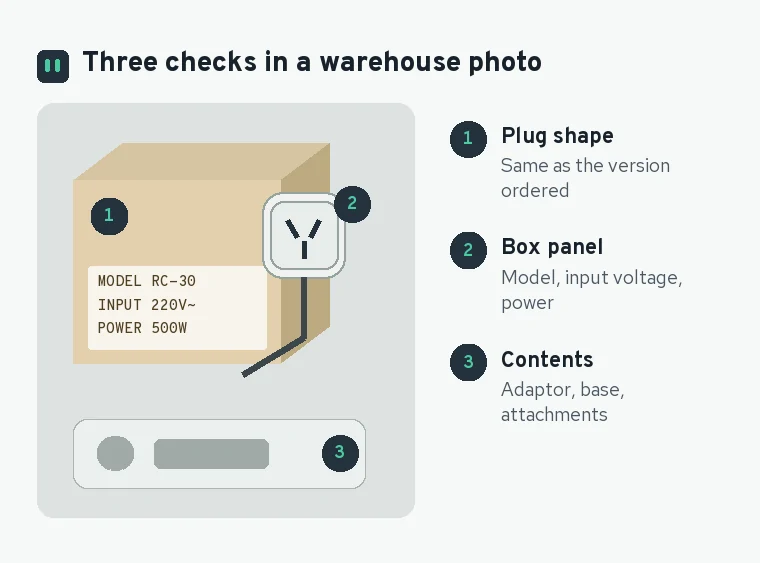
Look first at the plug: the shape in the photo should match the listing and the version you ordered. Then look for any printed panel on the box, which on small appliances often repeats the model, the input voltage and the power. Then count what is in the bag against the listing: the adaptor, the base, the attachments.
What the photos cannot show is whether anything works or whether something rattles inside. If a quality check photo shows the wrong plug or a different model on the box, raise it with 100buy straight away; that is the moment when a mismatch is simplest to deal with.
Sealed boxes and the short window for returns
Appliances often arrive at the warehouse in a sealed box, and the seal matters later. 100buy’s Return and exchange services page gives 120 hours from the moment an item shows as stocked in, asks that one-time sealed packaging stays sealed, and leaves the outcome to the seller.
Put next to the inspection rules, the consequence is plain. The warehouse does not test the item, and testing it yourself means breaking the seal, which is not possible until it has been posted to you. An appliance is not something you can try before deciding to keep it.
So the reading belongs before payment, not after delivery. Every check on this site happens before the window opens: the plate, the plug, the marks, the battery question. The box is opened once, at your end.
What 100buy says about quality and authenticity
100buy’s purchasing notes prohibit buying counterfeit goods. They describe refusing such orders, suspending or closing accounts and disposing of counterfeit items found in its warehouse at the buyer’s cost. Alongside that, its product pages carry a short disclaimer that applies to every item, mains goods included:
100buy cannot guarantee the quality or authenticity of the products.
For a plug-in item the practical reading is that the marks, the plate and the box are as the maker or seller printed them, and nobody between the shop and your door has checked them. That is the same conclusion the rest of this page reaches from the inspection rules.
Checks after the parcel arrives
When the parcel arrives, a few minutes of care costs nothing. These are ordinary consumer checks, not electrical work.
- Read the plate on the item itself and compare it with what you expected. Labels on boxes and plates on items occasionally disagree.
- Look over the cable and the plug for cuts, crushed sections or loose pins from the journey.
- Use an adaptor that takes every pin and sits firmly, and plug in nothing else on the same adaptor.
- Do not power an item merely to see whether it works if its compatibility or condition is uncertain. Stop using a product that overheats, smells burnt or behaves abnormally; follow the manufacturer’s instructions and get qualified advice.
- Keep the box and paperwork until it has run normally for a while.
If something is wrong, contact 100buy promptly with photos; its after-sales pages set short deadlines, and the details are on its own site.