
Volts and hertz: the mainland supply against the supply in your house
Mainland homes run at a nominal 220 volts and 50 hertz. Britain, most of Europe, Australia and New Zealand sit close to that; North America does not.
Where your supply sits next to the mainland’s
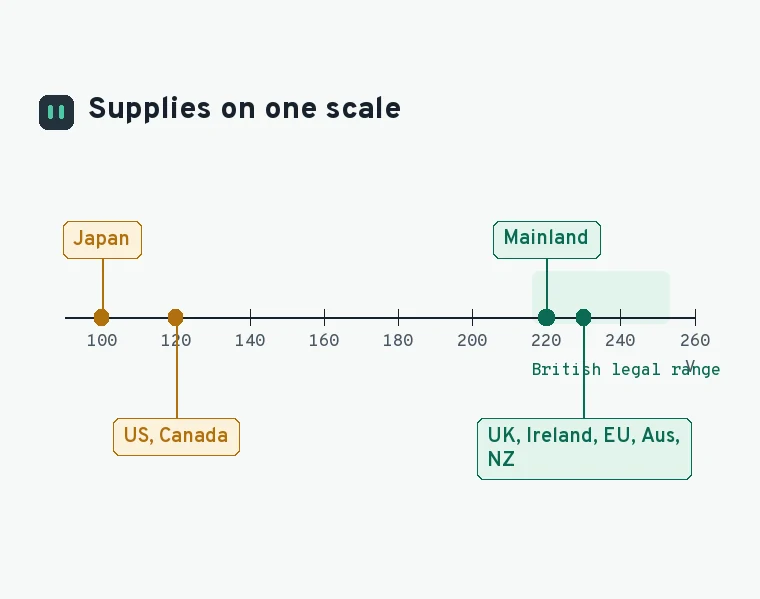
Mainland homes run at a nominal 220 V and 50 Hz. Public travel guidance gives 230 V and 50 Hz for the United Kingdom, Ireland, France, Germany, Australia and New Zealand, 120 V and 60 Hz for the United States and Canada, and 100 V for Japan.
For British readers the legal figure is precise. The Electricity Safety, Quality and Continuity Regulations 2002 set the declared supply at 230 V between phase and neutral, allowed to vary from 10 per cent above to 6 per cent below, and the frequency at 50 Hz within 1 per cent either way. That puts the British supply anywhere from about 216 V to 253 V on a given day.
Broad voltage families help explain why markets differ, but each appliance has its own permitted input. Compare the exact local supply with the complete rating and manufacturer instructions. A nominal 220 V label is not automatically a 220–240 V range.

Single-voltage items on a 230 volt supply
A label showing one nominal figure must be read with the manufacturer’s permitted input range. Different products have different tolerances; their internal power supply or heating element cannot be assessed from a catalog photograph. Ask for confirmation if the local supply falls outside the stated range.
The socket card therefore identifies what remains to be verified. It does not give a safety pass based on a small voltage difference. Frequency, plug standard, earthing and the appliance’s condition still matter even when the voltage range appears suitable.
The case to watch is the high end of the British range. If your supply sits near the top of its allowance, a heater running continuously for long periods is working harder than its designers had in mind. Short jobs, such as a kettle or a hair dryer, are the ordinary use for these items.
Step-up converters for 120 volt homes
An appliance with an input rating outside the local supply should not be connected directly. Converter suitability depends on more than the wattage printed on a label, including load type and the maker’s instructions. Ask the manufacturer or a qualified professional; buying a locally rated item can avoid that uncertainty.
Wide-input items need no converter anywhere, which is why chargers bought from mainland shops travel well. The plate’s range covers both families of supply, and the only purchase is a plug adaptor.
Running a 220 V heater on 120 V mostly leaves it weak, while motors and electronics on too little voltage can behave unpredictably, so it is not a test worth making. The reverse mismatch is the one public safety guidance calls extremely dangerous: a 110 to 120 V item on a 230 V supply. If a seller offers a version for another market, make sure the version you receive is the one your supply needs.

Mains frequency and the motors that notice it
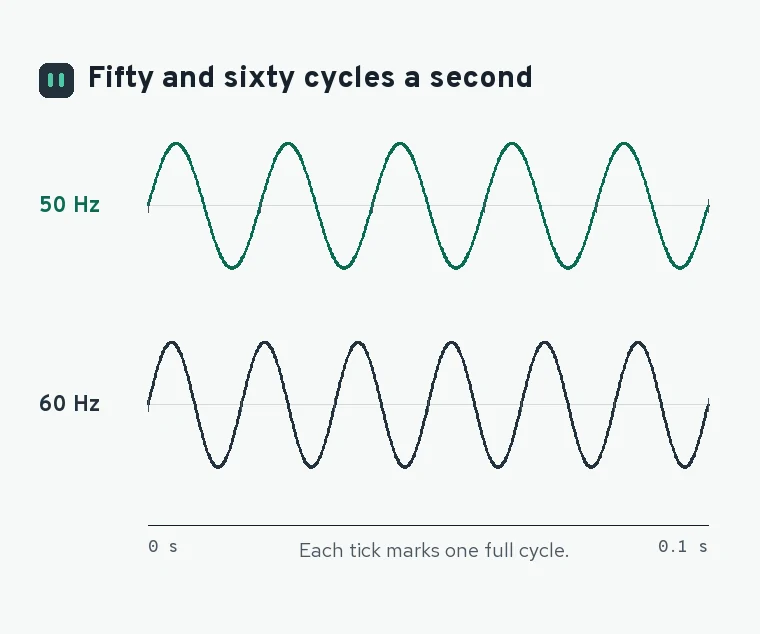
Alternating current reverses direction many times a second: 50 times on the mainland, in Britain, Europe, Australia and New Zealand, 60 times in North America. Public safety guidance notes that a different frequency can affect how an appliance runs, and gives the example of a 50 Hz clock running fast on a 60 Hz supply.
Motors are the main concern. A simple induction motor, the kind in many desk fans, turns at a speed tied to the supply frequency, so on 60 Hz it usually spins about a fifth faster than designed and can run warmer. Motors with brushes, common in hair dryers and blenders, are less tied to frequency, and chargers turn the supply into direct current early, so they usually do not care at all.
For readers on 50 Hz supplies, the frequency line is nearly always a match. For readers on 60 Hz, a plate that says 50Hz only, on anything with a fan or a timer, is the cue to ask the seller or look for a 50/60Hz model.
Timers, clocks and anything that counts the mains
Some appliances keep time by counting the supply rather than by a crystal of their own. A clock built that way on a 60 Hz supply counts 60 cycles where it expects 50, so every hour it believes 72 minutes have passed and it gains about 12 minutes. Rice cookers with delay timers, bread makers and bedside clock radios are the kind of item where this can show up.
Whether a particular item counts the mains is rarely printed anywhere, so treat it as a possibility rather than a certainty. If your supply is 60 Hz and the plate says 50Hz only, assume any clock or programme timer may drift and check it against your phone in the first week.
Converters, heat and a sensible stopping point
There is a point where reading the plate tells you not to buy. A single-voltage heater for a 120 V home, a 50 Hz fan for a 60 Hz home that you plan to run all summer, or anything where the fix would mean opening the casing: these are better bought locally, made for your supply, with a warranty you can use.
A converter cannot be selected from wattage alone. Load type, starting current, frequency, earthing and manufacturer instructions also matter. Ask a qualified professional when compatibility is uncertain; choosing a product made for the local supply avoids many of these uncertainties. This site does not provide instructions for rewiring or altering an appliance.
The decision chart on this section is the short version. The socket card gives the same answer for a specific plate.
