
Rating plates on mainland goods, read line by line for your own socket
Every mains item carries a small block of figures on its base, back or charger. Read three of them and you know most of what matters before paying.
Socket card from the plate and your wall
Pick what you can actually read. Anything you cannot see stays as “Cannot see it”, and the card will say what to ask for.
The card is a reading aid, not electrical advice. Anything beyond a plug adaptor belongs with a qualified electrician.
The rating plate on the base or the charger brick
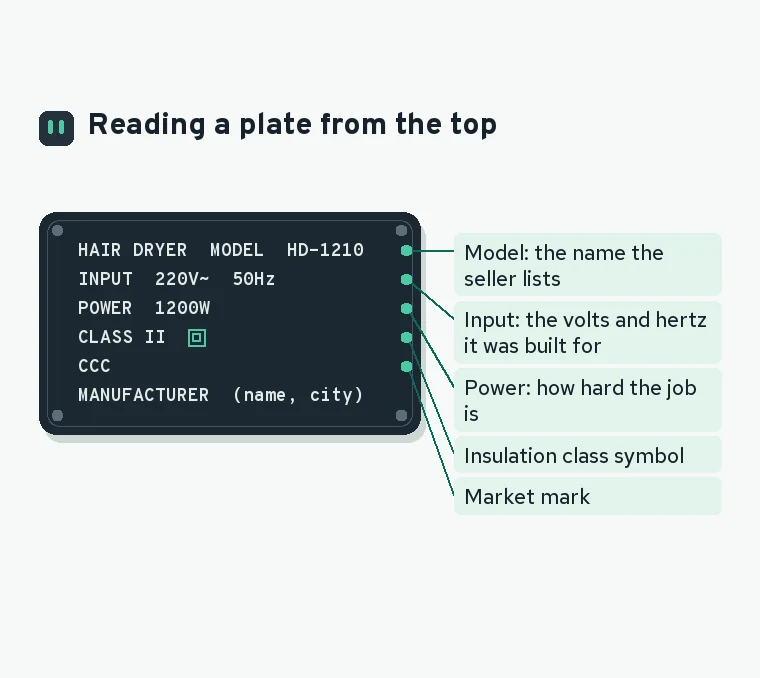
Every appliance made to plug in carries a small block of figures somewhere on its body. It may be a printed sticker, a metal plate or letters moulded into the plastic, and on mainland goods the words beside the figures are often in Chinese only. The figures and units are the same everywhere: V for volts, Hz for hertz, W for watts, A for amps.
Where to look depends on the item. Lamps carry it under the base or on the adaptor. Hair dryers and curling tongs usually have it on the handle or on a tag close to the plug. Kettles, rice cookers and blenders put it underneath, often on the motor base rather than the jug. Chargers and power adaptors print it on the brick itself, in small grey type that photographs badly.
A full plate normally holds the model, the input line, the power, the maker and a set of marks. The input line is the one that matters most: a voltage followed by a wavy line (~), meaning alternating current, and then a frequency. The sections below take the figures in the order you will need them.
Wide input ranges and single-voltage heaters
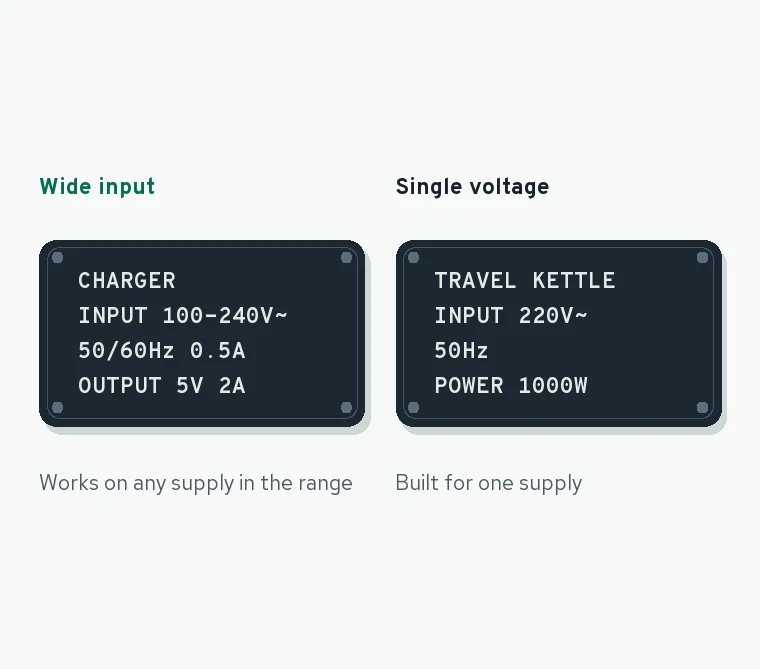
Plates come in two families. A wide-input plate shows a range, such as 100–240V~ 50/60Hz, which means the item accepts any supply in that span. Phone and laptop chargers, most LED lamp adaptors and many small electronics are built this way, because the same brick is sold in many markets. For these, the pins are the only thing to sort out.
A single-voltage plate shows one figure, and on mainland goods that figure is 220V~ 50Hz. Items that heat or turn a motor are often single voltage: hair dryers, curling tongs, kettles, rice cookers, blenders, fan heaters. Their heating elements are designed for one supply.
For a fixed resistive element, power varies with the square of voltage. That calculation does not establish the safe input range of a finished appliance, its controls or insulation. Use the manufacturer’s stated rating rather than treating a small calculated increase as permission to connect it.
Watts, amps and the size of the job
The power figure tells you how much the item draws, and so whether a converter is even a sensible idea. Plates give it in watts, or as a current in amps; volts multiplied by amps gives a rough wattage if only the current is shown. A phone charger’s input is usually a fraction of an amp; a kettle or hair dryer plate often runs to four figures in watts.
Voltage converters and transformers carry their own maximum power rating, and the item has to stay under it. Small travel converters are usually rated for chargers and shavers, not for heating. A step-up transformer big enough for a four-figure heater is a heavy piece of kit in its own right, which is why the practical answer for most heaters on the wrong supply is to buy one made for that supply instead.
Wattage also matters for adaptors. A plug adaptor carries the full current of the item through its own contacts, so a robust one rated above the item’s current is worth having for a kettle, while almost anything will do for a phone charger.
A photo of the plate before you pay
Listing photos are made to sell, so the plate is often missing or blurred. Asking for it is normal, and how a shop responds is a fair way to judge a seller of mains goods. Good sellers send a sharp photo of the whole plate within minutes, because their mainland customers ask the same thing.
A useful photo shows the full input line in focus, the plug face on with all pins visible, and ideally the side of the box with its printed specification. If the seller sends only a stock picture, or answers with a voltage in a chat message instead of a photo, treat the reading as unconfirmed and use “Cannot see it” on the socket card.
There is a limit to what a photo proves. It shows what is printed, not whether the unit inside matches it, and neither a photo nor 100buy’s warehouse check tells you the item works. That gap is why a warehouse photograph cannot be used as electrical-safety approval.
How to use the socket card
Here is how to use the tool at the top of this page, the site’s only one. It works from five choices and an optional sixth.
- Input voltage
- The figure before the ~ on the input line. Choose the range if the plate shows one.
- Frequency
- The Hz figure. “50/60Hz” means the item accepts either.
- Plug
- The pin shape in the photos. A plug with two flat pins in a V and no third pin counts as “Cannot see it” until you know which socket it is meant for.
- Marks
- Tick any letters you can see. The card explains what each one is a claim about.
- Your socket
- Pick by the holes, not by country. The supply setting follows the socket you pick, and you can change it if your home is an exception.
The card compares plug and socket first, then the plate’s voltage and frequency against your supply, then lists what the marks mean. It does not know about any particular product, so it cannot say an item is safe, only whether the readings line up. The pin rules it uses are drawn below.