
Marks moulded into a mainland casing and what each of them claims
Letters pressed into the plastic look official, but each is a statement by the maker under one market’s rules, and none of them is a test that we or 100buy carry out.
Marks moulded into the casing, read as claims
Letters pressed into the plastic of a mainland appliance look official, and some of them are. Each one, though, is a statement made under a particular market’s rules, usually by the maker, about that market. None of them is a test result for the unit in your hands, and none of them is something this site or 100buy’s warehouse checks.
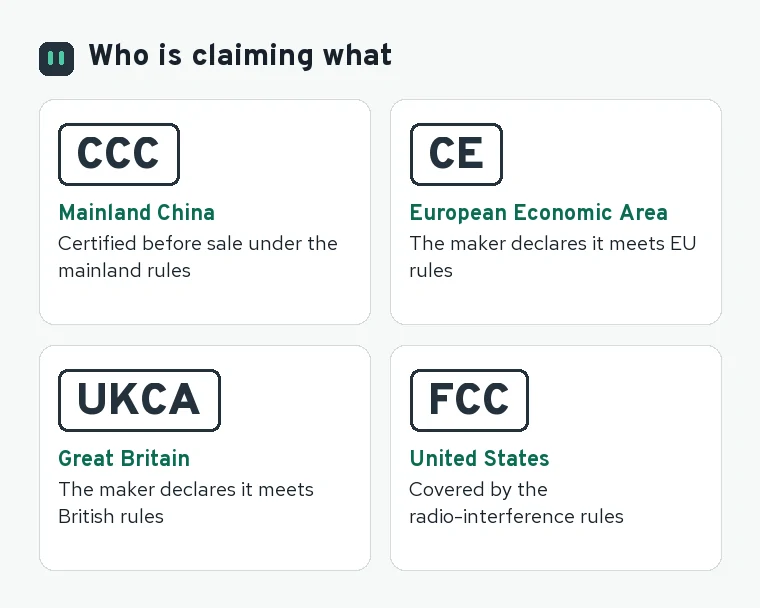
Read that way, the marks still tell you something useful. CCC says the item was certified for sale on the mainland. CE and UKCA say the maker declares it meets European or British rules. FCC says it falls under a US rule about radio interference. The symbols beside them, such as the double square or the wavy line, describe how the item is built and what supply it takes.
What the marks cannot tell you is whether the item is legal to sell where you live, whether this particular unit is sound, or whether the paperwork behind a printed mark exists. The last section of this page deals with that gap.
CCC, the mainland’s compulsory certification
China Compulsory Certification is the mainland’s own scheme. The rules on compulsory product certification, published on the State Council’s portal, say that products on the national list must be certified and carry the certification mark before they leave the factory, are sold, are imported or are used in other business activities. Many household electrical goods are on that list.
On a catalogue item, then, CCC is the mark you would expect to see: the item was made for sale in mainland shops, and the maker went through the mainland process for it. That is reassuring about the item’s intended market and says nothing about yours: CCC is a mainland scheme, and it is not how other countries’ rules are met.
A mark is also only a mark. We cannot confirm a certificate from a photograph, and nor can the warehouse. If a plug-in item carries no CCC mark at all, that is worth noticing, since mainland shops selling listed products to mainland homes are expected to have one.
CE and UKCA, a maker’s own declaration
The European Commission’s page on CE marking puts it directly: by affixing the CE marking, a manufacturer declares that the product meets all the legal requirements for it and can be sold across the European Economic Area. The same page notes that not every product needs it and that it applies equally to goods made outside Europe.
Britain’s version reads the same way. The government’s guidance on UKCA and CE marked products says the two markings demonstrate that the manufacturer believes the product meets the relevant requirements, and that Great Britain continues to recognise CE alongside UKCA.
A declaration is a promise backed by paperwork the maker keeps. On a mainland-market item it may be there because the same model is also sold in Europe, or it may simply be part of the moulding. From a listing photo you cannot tell which, so read CE or UKCA on a catalogue item as “the maker says so”, not as “someone checked”.
FCC, a rule about radio interference
FCC refers to the United States regulator for communications. The rules most consumer electronics fall under are in Part 15 of Title 47, which covers devices that give off radio-frequency energy, deliberately or as a side effect, and can be used without an individual licence.
So an FCC mark is about interference: whether a device’s electronics keep their radio noise within limits. It is not a statement about electric shock, overheating or fire, which are the questions a buyer of a hair dryer or kettle actually cares about.
You will mostly see it on chargers, speakers and gadgets with electronics inside. On a mainland item, it is another market’s mark and carries the same caveat as CE: printed by the maker, unchecked by anyone you can reach.
The double square and other symbols on the plate
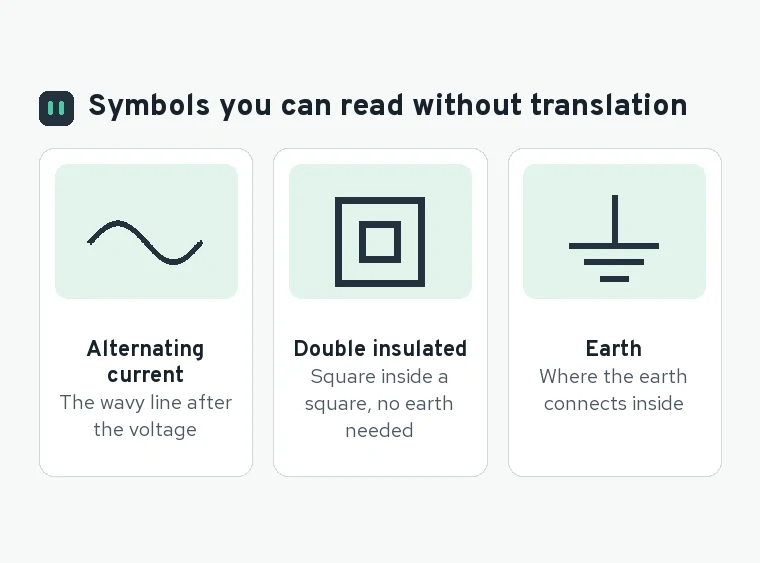
Besides the letters, plates carry a few symbols worth knowing. The wavy line after the voltage (~) means alternating current, the kind every home socket supplies. A plate that shows a straight line instead, usually with dashes beneath it, is describing direct current, which you will see on the output side of chargers.
A small square inside a larger square marks double insulation, also called Class II: the live parts are wrapped so that the item does not rely on an earth connection. Two-pin lamps and chargers often carry it. An earth symbol, a vertical line over three horizontal ones, marks where an earth connects inside equipment that does need one.
None of these symbols needs translating, which helps when the words on a mainland plate are all in Chinese. If you can find the wavy line, the voltage and the hertz, you have the input line.
What none of the marks can tell you
Put all of it together and the marks answer one question well: which market the maker had in mind. They do not answer the questions that decide whether to buy.
- Whether the item may be sold where you live. That depends on your country’s rules and on who sells it, not on what is moulded into it.
- Whether this unit is sound. A mark describes a design, not the one in your parcel.
- Whether the paperwork exists. Neither a photo nor a warehouse glance can confirm a certificate or a declaration.
- Whether it suits your supply. That is the plate’s job, and the socket card’s.
This is also why we do not use marks to rank items or sellers. A missing CCC mark on a plug-in item is worth asking about; a full row of letters is not, on its own, a reason to relax.