Field notes
100buy Spreadsheet: the detailed reading room
The original specialist explanations and interactive tools, collected in one place. Start with the buying guide for the full order journey.
A socket card from four readings
Most of what goes wrong with a mains item from a mainland shop can be seen before you pay. The plate on the base or on the charger brick says which voltage the item wants and how often the current should alternate. The plug in the listing photos says which wall it was made for. Put those next to a picture of your own wall socket and the picture is usually clear.
Our socket card does that sum in plain words. You pick what you can read on the plate, the plug shape you can see, any letters moulded into the casing, and the shape of the holes in your wall. Back come four short lines: whether the pins fit, whether the voltage suits your supply, whether the frequency matters for this kind of item, and what the printed marks do and do not prove.
It never asks for a country, a price or a model number, and where you cannot see something it says so rather than guessing. The card always ends with one fixed line about 100buy, because its warehouse check stops at the outside of the box: the item is looked at, counted, repacked, and not switched on.
Open the socket card, or read how a plate is laid out first.

The 100buy Spreadsheet catalogue, read for the mains
The 100buy Spreadsheet is a product catalogue. Shelves of entries cover things sold by shops on mainland Chinese marketplaces, each entry with a photo and a link through to the listing, so you can browse by shelf and then buy through a shopping agent such as 100buy. It is a place to look around, not a document to fill in.
This site keeps the same shelves but reads only one detail on them: whether an item takes power from the wall. That narrows things quickly. Of the shelves in the catalogue, only electronics and headphones hold anything with a rating plate, and on those two the battery rule removes most entries.
What is left is a short list: chargers and adaptors on their own, desk and bedside lamps, hair dryers and curling tongs, travel kettles, rice cookers, blenders and other small kitchen appliances, and wired keyboards, mice and speakers that draw power from a socket or a computer. Every page here is about that list.
The Spreadsheet page links every shelf and says which ones ever meet a socket.
100buy, and what its warehouse does with a mains item
100buy is a shopping agent that does the buying for you from mainland marketplaces. Send it a listing from Taobao, Tmall, 1688, Weidian or another mainland marketplace and it places the order with the shop, takes delivery at its warehouse in China, and posts the goods on to you, usually together with your other orders. The order form and parcel pages sit behind a login, so what follows comes from 100buy’s public help pages, read on 19 October 2026.
For anything electrical the warehouse step is narrower than many buyers assume. 100buy’s Inspection Information page and two of its answers on quality checks describe a look at the outside: whether the casing is intact and whether the accessories are all in the box. They also say the goods are not powered up. Nobody plugs your lamp in to see if it lights.
Read the full input rating before you pay, and establish compatibility before considering use at home. What the warehouse sees sets out the practical side, including the battery rule and the short return window for sealed boxes.
From a catalogue entry to the first switch-on
Here is the whole route for one mains item, step by step. None of it needs special tools; most of it is looking at photos before you commit.
- Open the entry and go through to the listing. Look for a photo of the plate (under the base, on the back, on a tag near the plug, or printed on the charger) and a clear photo of the plug.
- If either is missing, ask the seller before paying. A shop that sells into mainland homes can usually send a photo of the plate in a minute.
- Read the plate: the input voltage, the frequency and the power figure. Rating plates goes through each line.
- Decide what your home needs: nothing, a plug adaptor, or a voltage converter, and whether a converter makes sense for this item at all.
- Order through 100buy. When the warehouse photos come through, check that the plug and the contents match the listing.
- When it arrives, compare the item and its manufacturer instructions with the order. Confirm the full local-supply requirements before considering use. If anything is unclear or damaged, leave it disconnected and ask a qualified professional.
Steps three and four are where most mistakes are made, and they are the ones the socket card is for.
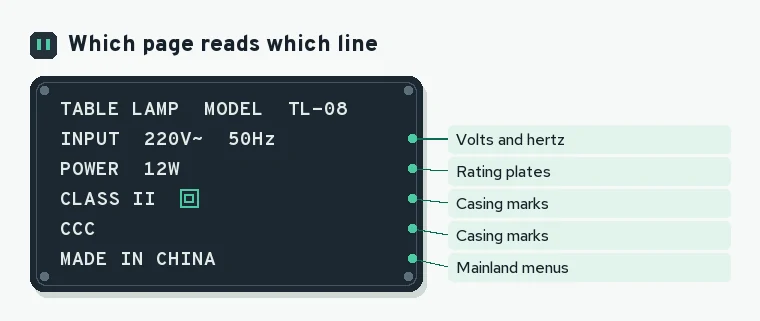
The rest of the site, page by page
Each page takes one line of the plate, or one stage of the route, and stays with it.
- Spreadsheet
- Every catalogue shelf, with the two that hold plug-in goods read entry by entry.
- Rating plates
- Where the plate sits, how to read it, and the socket card itself.
- Plugs and adaptors
- Mainland plug shapes, the holes in your wall, and what an adaptor does not do.
- Volts and hertz
- The mainland supply next to yours, converters, and the motors and timers that notice the difference.
- Casing marks
- CCC, CE, UKCA, FCC and the symbols beside them, read as the claims they are.
- Mainland menus and accounts
- Apps, logins, manuals and paperwork set up for a mainland home.
- What the warehouse sees
- The visual check, the battery rule, sealed boxes and what 100buy says about quality.
- Questions
- Short answers, the words printed on plates, and the money lines on an order.
- About
- Who keeps the site, the company behind 100buy, and how each fact was checked.