
Mainland plug shapes and the wall they meet in your home
A mainland item arrives with the plug it was sold with at home. What happens next depends on the holes in your wall, and on remembering that an adaptor only moves pins.
Plug shapes used in mainland China and the adaptors between them
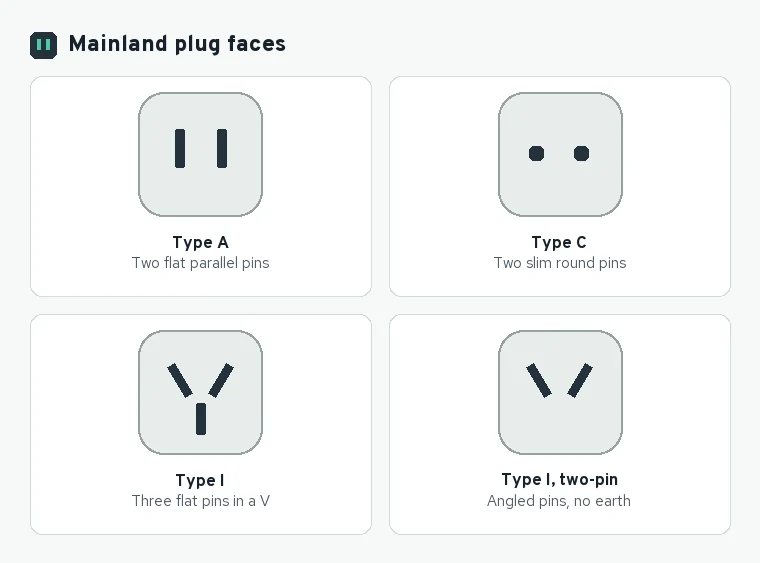
Public travel guidance lists three plug types for mainland China. Type A has two flat parallel pins and no earth. Type C has two slim round pins. Type I has two flat pins set in a V plus a flat earth pin, and a two-pin version of it, without the earth, exists as well.
On catalogue goods you will mostly meet the flat-pin shapes. Small chargers, lamps and adaptors usually come with two flat pins, either parallel or angled. Appliances with a metal body or a heating element, such as kettles, rice cookers and some hair dryers, usually come with the three-pin V-shaped plug, because their earth needs a path.
A mainland shop rarely mentions its plug in the listing at all, because at home it is the only kind its customers use. The plug is simply part of the product, like the colour of the cable. Your socket is another matter, and the photos are where to check it.
Adaptors change the pins, converters change the voltage
A plug adaptor is a shape changer. It lets a mainland plug enter your socket, and that is all it does: public electrical safety guidance is explicit that a travel adaptor does not convert the voltage or the frequency. A 220 V item on an adaptor still receives whatever your supply delivers.
A voltage converter, or transformer, changes the voltage. Step-down units take a higher supply down for a lower-voltage item; step-up units do the reverse. Neither changes the frequency, and each has a maximum power rating that the item must stay below. Many converters come with plug adaptors built in, which is a convenience, not a third kind of device.
So the question for any mainland item has two parts that never merge. First: do the pins fit, with or without an adaptor? Second: does the plate suit the supply, with or without a converter? The socket card keeps those answers on separate lines for that reason.
Your wall, picked by its holes
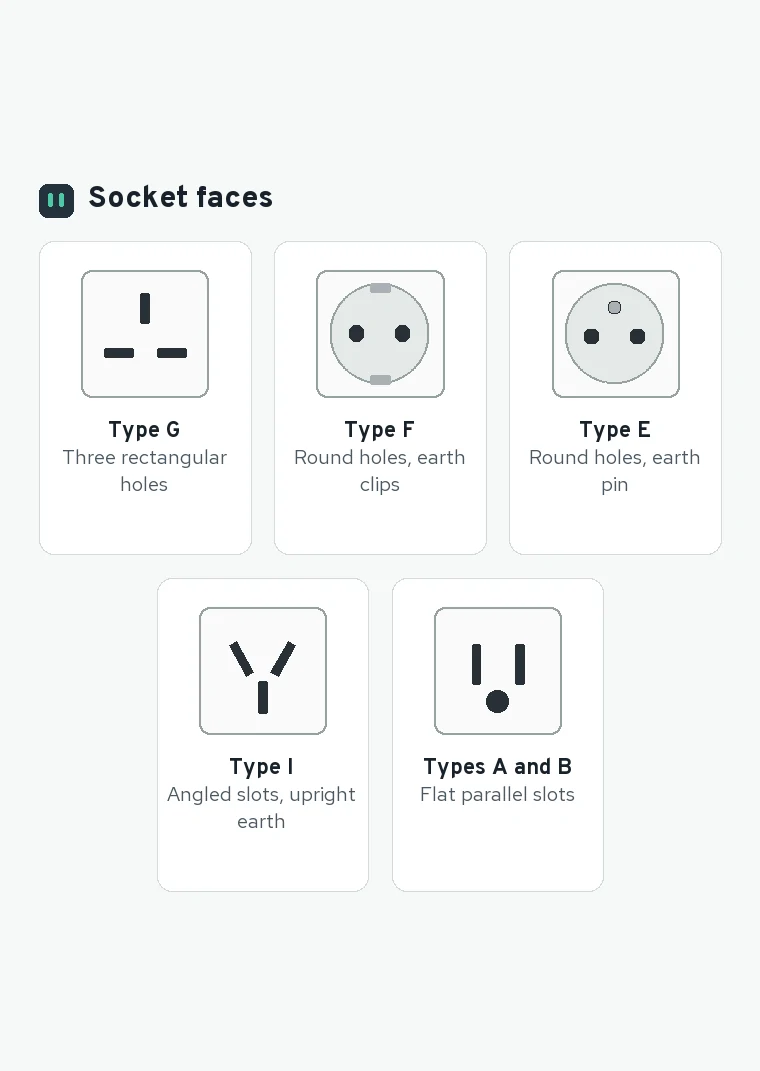
Every socket on this site is described by its holes rather than by country, because that is what you can check by looking. The same public guidance gives these pairings for the homes this site has in mind:
| Socket you see | Usual type | Homes | Supply |
|---|---|---|---|
| Three rectangular holes | G | United Kingdom, Ireland | 230 V, 50 Hz |
| Two round holes with earth clips | F | Germany | 230 V, 50 Hz |
| Two round holes with an earth pin | E | France | 230 V, 50 Hz |
| Two angled slots and an upright one | I | Australia, New Zealand | 230 V, 50 Hz |
| Two flat slots, maybe a round earth hole | A, B | United States, Canada | 120 V, 60 Hz |
| Two flat slots | A, B | Japan | 100 V |
Two slim round mainland pins fit the round-hole sockets of Germany and France, where the same type C plug is listed. Flat parallel pins fit North American and Japanese sockets. Everything else needs an adaptor, and the supply column decides whether a converter is needed too.
Two V-shaped plugs that are not quite the same
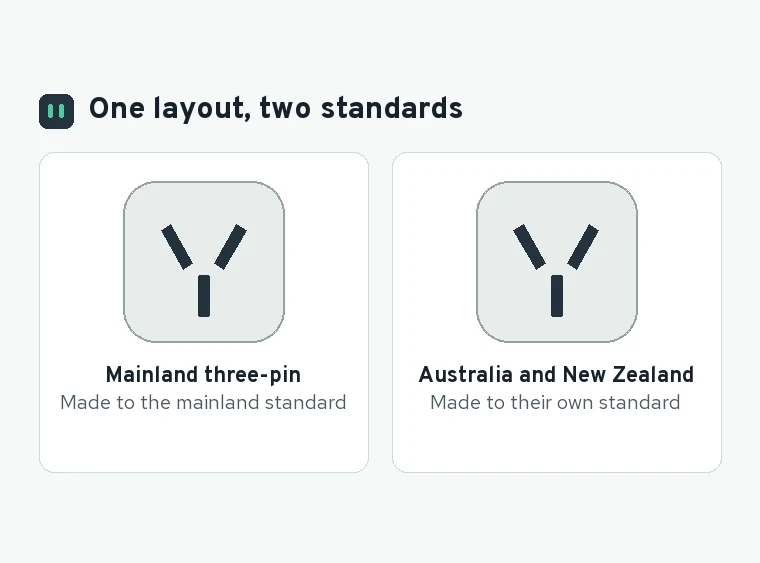
Australia and New Zealand use the type I socket, the same V-shaped layout as the mainland three-pin plug, so a reader there may expect a mainland kettle to plug straight in. The layout matches, but the two plugs are made to different national standards.
We could not find an official source confirming that every mainland plug seats fully in every Australian or New Zealand socket, so we do not say it will. Look at the plug when it arrives: the pins should go fully home and the plug should sit flat against the faceplate. If it sits loose or proud, use an adaptor made for the purpose rather than pushing harder.
Australia and New Zealand use nominal 230 V supplies, but a label stating only 220 V does not by itself confirm the permitted range. Check the manufacturer’s instructions and local plug requirements; do not assume that matching the pins resolves compatibility.
Earth pins, two-pin plugs and metal bodies
The third pin on a type I plug is the earth. It gives a fault in a metal-bodied appliance somewhere to go other than the person holding it, and it is why kettles and rice cookers usually ship with three pins. A three-pin item expects that earth to stay connected all the way to your wall.
Two-pin items are usually built so they do not need an earth: their live parts are wrapped in two layers of insulation, shown on the plate by a small square inside another square. A lamp or charger with two pins and that symbol is designed to work without the third pin.
In practice that gives one rule for adaptors. Whatever you use must accept every pin the plug has, earth included, and carry the current on the plate. An adaptor that leaves the earth pin with nowhere to go does not suit a three-pin item; settle that with a proper adaptor or a qualified electrician, not by improvising.